


Table of Contents:
- Start with the why: Can visitors understand your value in five seconds?
- Simplicity is strategy: Startup website best practices for clear communication
- Competitive differentiation: Different, not just better
- Discoverability: SEO and Answer Engine Optimization
- Social proof and trust signals: Why visitors leave before converting
- Mobile-first experience: Meeting customers where they are
- Page speed and technical performance: Table stakes
- Conversion infrastructure: How to make your website generate leads
- Bringing it all together: Your website as a revenue engine
- Your website is a revenue generator, not an expense
- References
Your website is the hardest-working member of your sales team, yet most entrepreneurs don’t have a website strategy that reflects it. This guide walks CEOs, founders, and startup leaders through nine interconnected essentials that transform a website from an expense into a revenue engine: leading with problem-value clarity, writing for the uninformed visitor, articulating competitive differentiation, building discoverability through SEO and answer engine optimization, earning trust with specific social proof, designing for mobile first, ensuring fast page speed, integrating CRM to generate and nurture leads, and committing to the long timeline required for content marketing to compound. Each element reinforces the others as part of an interconnected system, and a breakdown at any point costs you revenue.
Website Strategy for Entrepreneurs: What Every CEO Should Know (But Probably Doesn’t)
What happens when a potential customer visits your website and can’t understand what you actually do? What happens when an investor lands on your website and leaves confused?
Most entrepreneurs treat their website as a digital brochure that can be checked off a list of todos. But here’s the reality: Your website is working 24/7 as your first, and often only, sales conversation. It’s pitching your solution when you’re asleep, fielding objections when you’re in meetings, and deciding whether prospects become customers or bounce to your competitors. A deliberate website strategy is the difference between a site that generates revenue and one that just exists.
Through my work helping companies refine their digital presence, I continually see the same problem. The businesses that win aren’t always the ones with the best product; they’re the ones whose websites function as complete systems. They clearly articulate problems and value, they simplify the experience for new visitors, they’re discoverable through search, they build trust, and they convert leads into pipeline. Let’s break down each one.
Start With Why: Can Visitors Understand Your Value in Five Seconds?
Can a complete stranger land on your homepage and understand, in five seconds, what problem you solve and why it matters to them? If not, you’re missing revenue opportunity.
The most common mistake entrepreneurs make is leading with features, jargon, or an “about us” story.1 Your potential customer doesn’t care that you’re “a next-generation platform leveraging AI-powered solutions.” They care that they’re losing $50,000 a month to manual data entry errors, and you can cut that by 80%.
Your website must convey three things immediately: the problem your customer faces, what it’s costing them (in time, money, or sanity), and the specific value your solution delivers. Focus on tangible outcomes, not vague promises. Do you reduce customer churn by 30%? Cut procurement cycle time from weeks to days? Help them avoid compliance penalties?
Think of your homepage as the opening line of a sales pitch. You wouldn’t walk into a meeting and spend ten minutes talking about your company history before mentioning what you do. Your website shouldn’t either.
Simplicity Is Strategy: Startup Website Best Practices for Clear Communication
Assume your visitor knows absolutely nothing about your industry, your competitive landscape, or the product names and acronyms you throw around at team meetings. Because they probably don’t.
Founders suffer from the curse of knowledge. You’ve been living and breathing your solution for years. You understand the nuances, the technical architecture, and the competitive advantages. Visitors arrive at your site at different stages of awareness and your site must bridge the gap.
Writing for the naive audience means using conversational language instead of corporate speak. It means structuring information hierarchically so visitors can scan and find what matters to them. It means clear calls-to-action at every stage of their journey, not just a generic “Contact Us” buried in the footer.
Here’s my clarity test: Could one of your relatives (who does not work in your industry) read your homepage and explain to a friend what you do? If not, simplify. Your visual hierarchy matters too. Use white space. Break up text. Make it scannable.2 People don’t read websites word-for-word, but instead, hunt for the information they need. Make that hunt effortless.
Competitive Differentiation: Different, Not Just Better
Every competitor in your space claims to be “the best.” They’re faster, smarter, more innovative, more customer-focused. It’s noise.
Your website must articulate what makes you different, not just better. Differentiation is about positioning yourself in a category of one, or at minimum, making a clear trade-off that resonates with your ideal customer.
You might not be the cheapest, but you’re the only solution built to address a full continuum of workflows. Perhaps you’re not the most feature-rich, but you can implement in 12 weeks instead of 12 months. Maybe your competitors offer more automation, but you provide a white glove service that eliminates the learning curve.
The key is to own something specific.3 Be crystal clear about who you serve and, just as importantly, who you don’t. Trying to appeal to everyone means you’ll resonate with no one.
This differentiation should be woven throughout your messaging, from your tagline to your feature descriptions to your case studies. It should be the thread that makes your positioning memorable and defensible.
Discoverability: SEO and Answer Engine Optimization
You can’t convert visitors you don’t have.
The best website in the world is worthless if no one can find it. And here’s the challenge: Search is evolving fast. Traditional SEO still matters,4 but we’re now living in the age of answer engines with ChatGPT, Perplexity, Google’s Search Generative Experience, and others that directly answer questions instead of just listing links.
This is where thought leadership content becomes your growth engine. High-quality, problem solving content does three critical things:
- First, it builds topical authority.5 When you consistently publish deep, valuable content around your core topics, search engines recognize you as an expert worth ranking.
- Second, it captures long-tail, high-intent searches.6 Someone searching “how to reduce SaaS churn for B2B companies” is much closer to buying than someone searching “CRM software.” Your content should target these specific pain points.
- Third, it positions your site to appear in AI-powered search summaries.7 Answer engines pull from authoritative sources that directly answer questions. If your content is comprehensive, well-structured, and genuinely helpful, you’ll show up when prospects ask questions in natural language.
Content formats that perform include in-depth how-to guides, comparison articles, problem solving frameworks, and thought leadership that takes a clear stance on industry debates. This isn’t about keyword stuffing. It’s about creating useful resources that answer the questions your ideal customers are asking.
The compound effect8 of consistent, high-quality content is staggering. Every piece you publish becomes a permanent asset that can drive traffic and leads for years, and consistent publishing creates exponential search exposure. Each new article strengthens your domain authority, each internal link passes value to older content, and search engines increasingly recognize you as the go-to source in your space. But “permanent” doesn’t mean “set it and forget it”. It is important to regularly revisit old posts to update statistics, refresh examples, and ensure accuracy as your industry evolves, because timeless content still requires maintenance to stay credible and competitive.
Social Proof and Trust Signals: Why Visitors Leave Before Converting
Even if your messaging is clear and your content brings in traffic, there’s still a big hurdle: trust.
Your visitor is asking themselves, “Can I trust this? Have other companies like mine succeeded with this solution? What are the risks?” A good site answers all three, and fast.
This is where social proof and trust signals become conversion accelerators. Testimonials from recognizable customers, detailed case studies with real metrics, customer logos, third-party reviews, industry certifications, and security badges all reduce the psychological friction of taking the next step.
Here’s the catch: Generic social proof doesn’t work. “Great product, highly recommend!” tells your visitor nothing. Effective social proof is specific and relevant. It features someone in a similar situation, facing a similar problem, who achieved measurable results.
A case study showing that your solution “helped a 50-person SaaS company reduce customer onboarding time from 6 weeks to 10 days, resulting in a 40% improvement in time-to-value” is worth ten generic testimonials.
Place trust signals strategically throughout your site. They should appear exactly when doubt creeps in: on pricing pages, next to CTAs, and in product descriptions. Think of them as your silent salespeople, answering objections before they’re even voiced.
Mobile-First Experience: Meeting Customers Where They Are
The data is overwhelming: The majority of B2B research now happens on mobile devices.9 Your prospects are reviewing your site on their commute, between meetings, or late at night when they finally have time to think. If your website isn’t optimized for mobile – if its clunky, slow, or hard to read on a phone – then your message doesn’t matter because prospects won’t engage.
Mobile-first design isn’t just about making things smaller. It’s about reimagining the entire experience for a smaller screen, touch interactions, and on-the-go browsing. Navigation needs to be intuitive, forms need to be painless, and your core message needs to be just as clear on a 6-inch screen as it is on a 27-inch monitor.
Test your site on your phone right now. Can you easily understand what you do? Can you find the information you need? Can you fill out a contact form without wanting to throw your phone across the room? If not, you’re hemorrhaging opportunities.
Page Speed and Technical Performance: Table Stakes
Here’s a sobering stat: If your page takes longer than three seconds to load, you’ve already lost half your visitors.10
Page speed isn’t a nice-to-have. It’s table stakes. It impacts your search rankings, your conversion rates, and your visitor’s patience. Every additional second of load time decreases conversions. Slow sites signal to your visitor that you don’t have your act together, even if your product is phenomenal.
Technical performance also includes things like proper image optimization, clean code, reliable hosting, and mobile responsiveness. These aren’t sexy topics, but they’re foundational. If your site is slow or buggy, nothing else matters.
The good news is that technical performance is fixable. Invest in quality hosting, compress images, minimize unnecessary scripts, and regularly audit your site’s speed. Tools like Google PageSpeed Insights will tell you exactly what’s slowing you down.
Conversion Infrastructure: How to Make Your Website Generate Leads
Traffic without capture is wasted opportunity.
You’ve done the hard work: You’ve clarified your message, created valuable content, built trust, and attracted visitors. Now you need to convert that attention into actionable leads.
This is where CRM integration stops being a technical detail and becomes a revenue driver. It does more than “collect emails”. CRM systems intelligently capture, score, route, and nurture leads based on their behavior and intent.
Modern CRM integration allows you to see which pages a prospect visited, which content they downloaded, and how long they spent on each page. You can score leads based on engagement and automatically route high-intent prospects to sales while nurturing earlier-stage visitors with targeted content.
This closes the loop between marketing and sales. Your website becomes a source of qualified pipeline, not just vanity traffic metrics. You can measure true ROI: which content drives conversions, which channels bring quality leads, and where visitors drop off in the journey.
But here’s the reality check every CEO and Founder needs to hear: This doesn’t happen overnight.
Building an effective website requires patience and trust in the process. It takes time for content to be created, indexed by search engines, and judged as credible. It takes time for leads to move through their buying journey from awareness to consideration to decision. It takes time for search authority to compound and for your content library to reach critical mass.
You might publish great content today and not see meaningful traffic from it for three to six months. A lead might download your guide, go silent for eight weeks, then suddenly re-engage when their budget opens up or their pain point becomes acute. This isn’t a failure of your strategy. It’s the natural rhythm of B2B buying cycles and content marketing maturity.
The entrepreneurs who win are the ones who understand this timeline and commit anyway. They trust that consistent effort compounds. They know that every piece of content is a permanent asset. They recognize that the infrastructure they’re building today, the CRM integration, the lead scoring, the nurturing sequences, will pay dividends for years.
Without this infrastructure, you’re flying blind. With it, your website becomes an intelligent revenue engine. But only if you give it time to work.
Bringing It All Together: Your Website as a Revenue Engine
These elements aren’t separate initiatives. They are interconnected parts of a system designed to turn strangers into customers.
The visitor journey looks like this: They discover you through search or a referral, land on your site, and immediately understand the problem you solve. They scan your content effortlessly, see that others like them have succeeded with your solution, and trust that you’re credible. They can navigate easily on their phone, the site loads instantly, and when they’re ready to take the next step, the path forward is clear. Their information flows into your CRM, and they’re routed to the right next conversation.
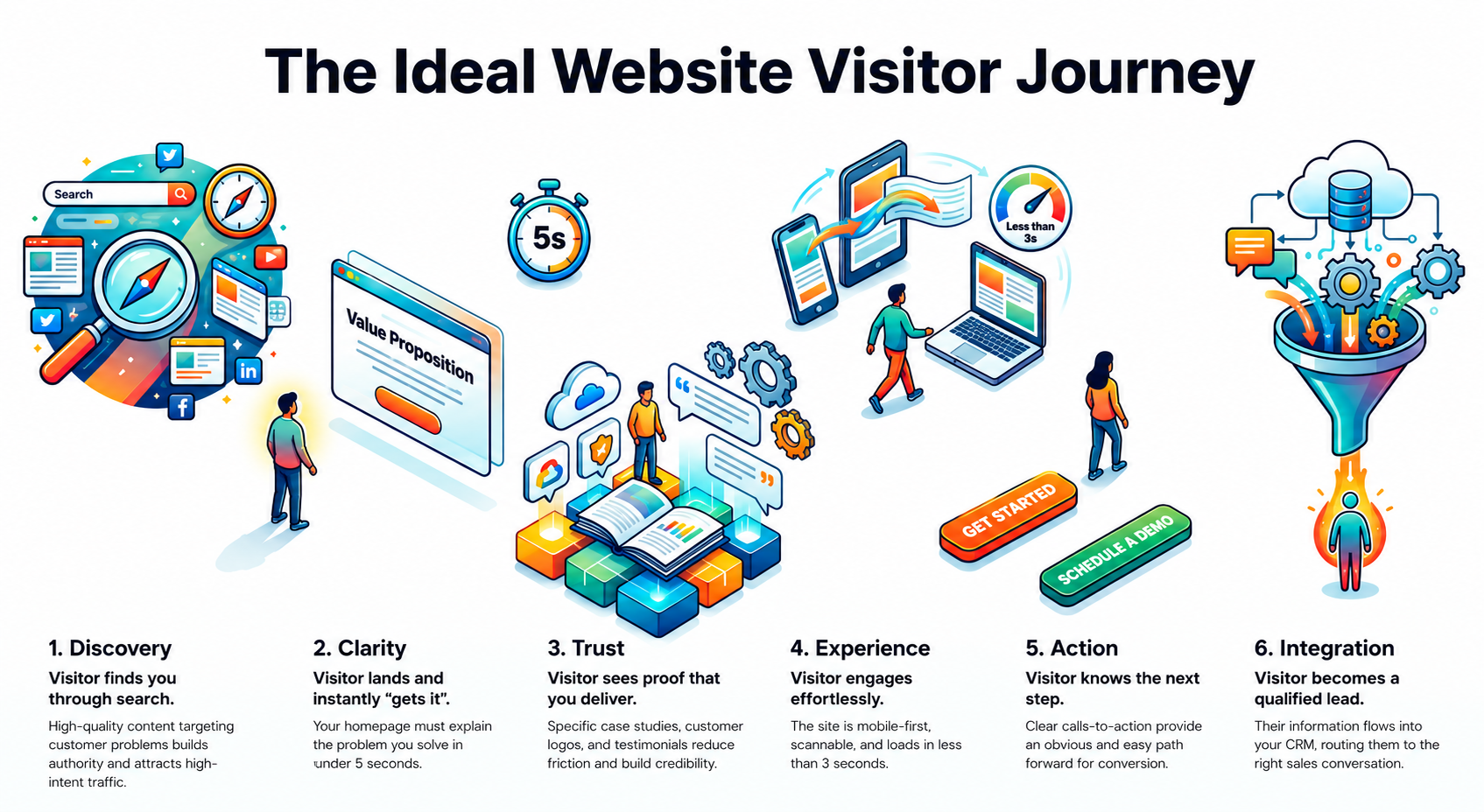
Every breakdown in this system costs you revenue. A slow site loses them before they read your message. Unclear positioning makes them bounce to a competitor. Missing trust signals causes them to hesitate. A broken mobile experience frustrates them. Poor CRM integration means sales never follows up.
Your Website Is a Revenue Generator, Not an Expense
Stop thinking about your website as an expense you need to minimize. Start thinking about it as the hardest-working member of your sales team. It never sleeps. It never has a bad day. It scales infinitely and, when built correctly, it compounds in value over time as content accumulates, search authority builds, and optimization improves.
Here’s my challenge to you: Audit your site through your customer’s eyes. Better yet, ask someone outside your industry to visit your homepage and explain what you do. Can they? Would they trust you? Would they take the next step?
If the answer is no, you know what to fix first.
Your website isn’t just representing your business. It’s running it. The right website strategy turns your biggest digital asset into your most reliable source of new business.
References
1. Javdani, M. (2025, August 4). The Biggest Mistake Entrepreneurs Make When Talking About Their Product. Entrepreneur. https://www.entrepreneur.com/growing-abusiness/the-product-communication-mistake-most-entrepreneurs-make
2. BigD Creative. (2021, August 31). 5 Ways to Make Your Site’s Design Scannable. https://www.bigdcreative.com/5-ways-to-make-your-sites-design-scannable/
3. Harr, E. (2022, January 12). Hinge Marketing. https://hingemarketing.com/blog/story/competitive-differentiation-a-playbook-forwinning-in-a-congested-marketplace
4. Madore, D. (2025, December 23). ChatGPT Search vs Traditional SEO: The Reality Check Nobody’s Talking About. DEV. https://dev.to/synergistdigitalmedia/chatgpt-search-vstraditional-seo-the-reality-check-nobodys-talking-about-k60
5. Go, S. (2024, June 26). What is Topical Authority? (+ How to Build It) (blog). Semrush. https://www.semrush.com/blog/topical-authority/
6. Saavedra, S. (2025, December 11). Long-Tail Keywords: How to Find & Use Them for SEO. MonsterInsights. https://www.monsterinsights.com/long-tail-keywords/
7. Lindley, A. (2025, November 6). How to Optimize Content for AI Search Engines [2026 Guide] (blog). Semrush. https://www.semrush.com/blog/how-to-optimize-content-forai-search-engines/
8. Reno, G. (2021, March 4). The Compounding Power of Content Marketing. Marketing Insider Group. https://marketinginsidergroup.com/content-marketing/compoundingpower-of-content-marketing/
9. Guan, S. (2025, July 3). 50 B2B Buying Stats That Every Sales Team Should Know (2025 Edition). Thunderbit. https://thunderbit.com/blog/b2b-buying-stats
10. Welland, M. (2024, September 18). Your slow page load speed could be losing customers and money. Niteco. https://niteco.com/articles/why-website-performance-load-speedimportant/
Frequently Asked Questions
1. How much does it cost to build an effective business website?
The investment varies widely based on complexity, but expect $10,000-$15,000 for a professional small business site with basic CRM integration, or $20,000-$50,000+ for more sophisticated platforms with custom functionality. However, the real cost isn’t the initial build. It’s the ongoing content creation, optimization, and maintenance. Budget for monthly content development ($1,000-$5,000) and technical maintenance ($1,000-$2,000) to keep your site performing as a revenue asset rather than a static expense.
2. Can I just use a website template or do I need custom design?
Templates work well for early-stage businesses with straightforward offerings, especially modern platforms with quality themes. The key isn’t custom vs. template; it’s whether your site clearly communicates your value proposition, loads quickly, and integrates with your CRM. A well-executed template site beats a poorly planned custom site every time. Focus on message clarity and functionality first, aesthetics second.
3. How long does it take for a website strategy to show results?
You’ll see impact within weeks for immediate fixes like page speed or mobile optimization. Expect 3-6 months before meaningful traffic increases for content marketing and SEO/AEO/GEO, and 6-12 months to build substantial search authority. Lead nurturing cycles add another 1-3 months depending on your sales cycle. This isn’t a weakness of the strategy, but rather the natural timeline for building credibility with search and answer engines, and moving prospects through their buying journey.
4. Do I really need a blog if I’m running a B2B business?
Yes, absolutely! You need a content hub with high-quality, problem-solving articles that establish topical authority and capture search traffic from prospects actively researching solutions. Think of it as your library of sales collateral that works 24/7. Companies that publish 16+ blog posts per month get 3.5x more traffic than those publishing 0-4 posts.
5. What if my industry is “boring” or too technical for content marketing?
There’s no such thing as a boring industry, only boring content. Every business solves problems, and people are actively searching for solutions to those problems. The more technical or specialized your industry, the more opportunity you have to become the authoritative resource. Your competitors likely aren’t investing in content, which means less competition for search visibility. Technical audiences especially value in-depth, expert content.
6. Should I hire an agency or build an in-house team for website management?
For most start-ups and small businesses, a hybrid approach works best: hire an agency or freelancer for the initial strategy, design, and technical setup, and bring content creation inhouse. Agencies excel at strategy and technical execution; in-house teams excel at authentic, deep industry knowledge.
7. How do I know if my website is working and generating ROI?
Implement proper CRM integration and analytics tracking from day one. Track these metrics: organic search traffic growth, conversion rate (visitors to leads), lead quality scores (likelihood to convert), content-to-customer attribution, and ultimately, customer acquisition cost. A website generating ROI will show increasing organic traffic month-over-month, a steady flow of qualified leads, and clear attribution from content to closed deals. If you can’t trace which content pieces drive conversions, your tracking infrastructure needs work.
8. Why is my website not generating leads, and should I focus on traffic or conversions first?
Both matter, but the order matters more. Start by optimizing conversion for the traffic you have, such as fixing your messaging, adding trust signals, improving the mobile experience, and speeding up load times. Once you’re converting 2-3% of visitors into leads (a reasonable benchmark), then scale traffic through content and SEO. Driving more traffic to a broken website is like pouring water into a leaky bucket. Fix the leak first.
9. How often should I update my website content?
Audit your core pages (homepage, product/service pages, about) quarterly to ensure accuracy and relevance. Review and refresh your top-performing blog content annually or when significant industry changes occur. Publish new content consistently, aiming for at least 2-4 highquality articles per month to maintain momentum. Search engines reward sites that demonstrate ongoing expertise and freshness, but quality always trumps quantity.
10. Do I need different websites for different products or can I use one site?
Unless your products serve completely different audiences with different buying processes, one cohesive website with clear navigation is almost always better. Multiple sites fragment your domain authority, complicate your SEO strategy, and confuse customers who might benefit from multiple products. Use clear site architecture with dedicated landing pages for each offering while maintaining unified branding and messaging. The exception: if you have distinct brands targeting different markets, separate sites may make sense.
11. What’s the difference between SEO and Answer Engine Optimization (AEO)/Generative Engine Optimization (GEO)?
Traditional SEO optimizes for ranking in search result lists. AEO/GEO optimizes for being featured as the direct answer in AI-powered tools like ChatGPT, Perplexity, and Google’s AI overviews. AEO/GEO requires more comprehensive, well-structured content that directly answers questions in natural language, uses clear headers, provides specific examples, and demonstrates expertise. The good news: content optimized for AEO/GEO also tends to perform well in traditional SEO, making it a win-win strategy.
12. How technical do I need to be to manage my business website?
You don’t need to code, but you should understand fundamental concepts: how CMS platforms work, basic SEO principles, analytics interpretation, and how your CRM integrates with your site. The goal is to be “technical enough” to have informed conversations with developers and make strategic decisions. Many modern platforms offer no-code interfaces for content management. Outsource the technical implementation, but own the strategy.
13. How do I manage my site’s SEO/AEO/GEO when I have other things to worry about?
I highly recommend hiring an agency to support your SEO/AEO/GEO efforts, which are complicated and constantly changing. An entrepreneur shouldn’t be distracted with this detail. I’ve worked with Wolfson Digital on SEO programs for several companies, and their methodology demonstrates what serious SEO looks like: They start by ensuring your analytics can actually measure success, then fix technical blockers that prevent search engines from understanding your site. Only after that foundation is solid do they move into audience persona research, keyword strategy, competitive analysis, and content optimization. This sequence matters because you can’t build authority on a broken foundation. Look for agencies that take a systematic, research-driven approach rather than making quickwin promises. Quality SEO work starts with proper analytics setup, technical foundation, and audience research, not just keyword stuffing or link building. Red flags include agencies that promise specific rankings quickly, focus only on vanity metrics like traffic volume without discussing conversions, or can’t explain their methodology in clear terms. Quality agencies should be transparent about timelines (3-6 months minimum to see meaningful results), educate you on the process, and tie everything back to business goals, not just search rankings.
14. What if my competitors aren’t investing in their websites. Do I really need to?
Your competitors’ underinvestment is your opportunity. If they’re neglecting their website strategy, you can capture search traffic, establish thought leadership, and become the go-to resource in your space with relatively less competition. Don’t benchmark against the worst in your industry, but rather, benchmark against the best customer experience possible. The fact that others aren’t doing it right, doesn’t change what your customers expect and deserve.
15. Can I write website content myself or should I hire a professional writer?
You can write your own content if you have the time, discipline, and clarity of thinking to do it well. The advantage: authentic voice and deep expertise. The disadvantages: founders often struggle to escape jargon, assume too much knowledge, and lack time for consistent output. But here’s the bigger issue. Even excellent communicators need marketing technical expertise. Effective website content requires SEO/AEO-optimized headers with strategic keyword placement, persuasive calls to action (CTAs), and user-focused messaging designed for conversion. Without this specialized knowledge, your content won’t perform no matter how well it’s written. Here’s where AI tools become game-changers: Modern AI writing assistants like ChatGPT, Claude, or Jasper can act as force multipliers for founders and small marketing teams. You provide the strategic direction, key points, and industry expertise, and AI helps with structure, drafting, and overcoming blank-page paralysis. This enables smaller teams to produce consistent, high-quality content without the cost of a full content team or agency. The most effective approach combines human expertise with AI efficiency: You outline the key insights and examples (the parts that require deep domain knowledge), use AI to generate initial drafts and variations, then refine and inject your authentic voice. This hybrid model lets founders empower small marketing teams to maintain content ownership and authenticity while dramatically reducing time investment. A piece that might take 6-8 hours to write from scratch can often be completed in 1-2 hours with AI assistance, making consistent content output actually achievable for busy teams.
16. What’s the single most important thing to get right on my website?
Problem-value clarity on your homepage. If a stranger can’t understand what problem you solve and why it matters to them within 5 seconds, nothing else matters. You can have perfect SEO, fast load times, and beautiful design, but if your core message is unclear, visitors will leave before experiencing any of it. Start here: rewrite your homepage hero section to clearly state the problem, the cost of that problem, and the specific value you deliver. Everything else builds from this foundation.